
Case 1 — Domino’s Pizza: The “Pizza Turnaround” (2008–2011)
1. Problem Statement
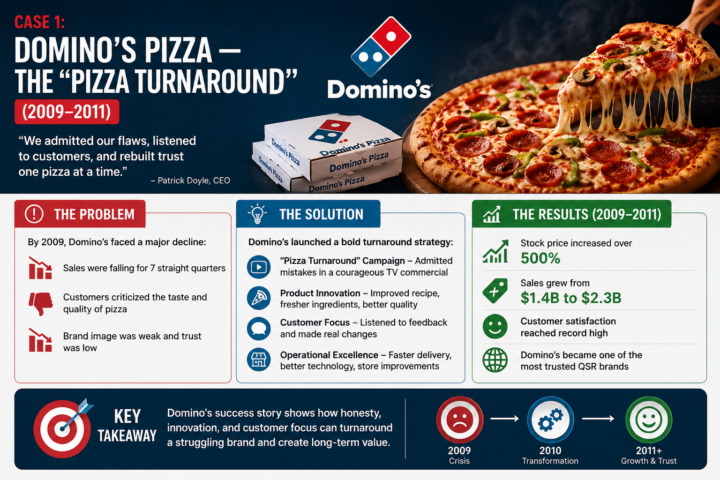
By 2008, Domino’s Pizza was the largest pizza delivery company in the United States by order volume, selling roughly one million pizzas a day. Despite this scale, the company faced a deepening brand crisis rooted in a genuine product-quality problem rather than a marketing gap. Domino’s own brand-tracking research placed its pizza dead last on taste among the three largest national pizza chains. Lost-customer surveys and focus groups repeatedly cited taste as the primary reason people had stopped ordering, with consumers describing the crust in openly unflattering terms and the sauce and cheese as forgettable. In early 2009, a video showing two employees mishandling food inside a Domino’s kitchen went viral, compounding the reputational damage even though the employees were fired and prosecuted. The financial impact was tangible and measurable: same-store sales were contracting and the stock, which had traded near $30 earlier in the decade, had fallen into the single digits during the 2008 downturn.
2. Data Snapshot — Where Domino’s Stood
3. Proposed Solution & Logic
Leadership, under then-president Patrick Doyle, concluded that no amount of advertising could repair a brand problem that was rooted in an actual, verifiable product deficiency — the pizza itself had to change first, and change demonstrably. The strategic logic rested on three pillars:
- Fix the product before promoting it: an entirely new recipe (crust, sauce, and cheese) had to outperform the old one in blind taste tests before any campaign launched.
- Radical transparency over deflection: rather than quietly reformulating and hoping customers noticed, Domino’s chose to publicly air its harshest criticism first, betting that honesty would rebuild more credibility than a polished, generic ad campaign.
- Make the turnaround the story, not just the new product: positioning Domino’s as a company humble and confident enough to admit failure was intended to differentiate it from competitors who never publicly acknowledged shortcomings.
4. Implementation
Domino’s R&D team rebuilt the hand-tossed pizza recipe from the ground up, iterating on crust, sauce, and cheese formulations until the new version scored substantially higher than the old recipe in blind taste comparisons. The company then hired a documentary film crew to capture real focus-group participants delivering candid, unscripted criticism of the old pizza — including comparisons to cardboard — and replayed this footage to Domino’s own executives and chefs on camera. This material became the centerpiece of the “Pizza Turnaround” campaign, a four-minute documentary-style commercial that aired nationally starting in December 2009, agency-partnered with Crispin Porter + Bogusky. The campaign ran across television, online video, and public relations simultaneously, and Domino’s committed to keeping paid media spend at or below prior-year levels, relying on earned media and word-of-mouth to amplify the message rather than simply outspending competitors.
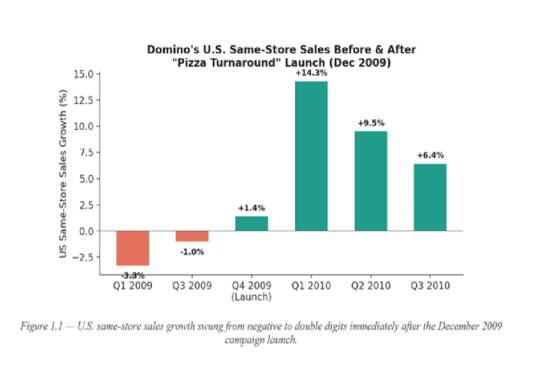
Figure 1.1 — U.S. same-store sales growth swung from negative to double digits immediately after the December 2009 campaign launch.
5. Change / Measured Impact
The results were immediate and well above typical marketing-campaign benchmarks. US same-store sales grew 14.3% in Q1 2010, an industry record for the QSR category at the time, and fourth-quarter profit more than doubled year-over-year to $23.6 million. Independent copy-testing by Millward Brown found the campaign’s breakthrough score 77% above the QSR norm and its persuasion score 176% above norm, placing it in the top one percent of all ads the firm had tested in the prior five years. The campaign won the Grand Ogilvy Award from the Advertising Research Foundation in 2011. Longer term, Domino’s stock rose from under $10 in 2008 to over $400 by 2017, making it one of the best-performing stocks in the S&P 500 across that period — a trajectory that analysts consistently trace back to the credibility rebuilt in the 2009–2010 turnaround.
Discussion Questions
- Why might publicly admitting a product failure be more persuasive than quietly fixing it and re-launching without comment?
- What risk was Domino’s taking by building an entire campaign around its own past criticism, and how did the company mitigate that risk?
- Could a transparency-first turnaround work in an industry where product quality is harder to demonstrate quickly, such as financial services or healthcare? What would need to change?