
Case 2 — Starbucks: Howard Schultz’s Return and the 2008 Turnaround
Industry: Specialty Retail / Food & Beverage | Type: Leadership-Led Operational Turnaround | Region: United States (global brand)
1. Problem Statement
Between 2004 and 2007, Starbucks pursued rapid store expansion in the US, opening locations at a pace that outstripped the company’s ability to maintain a consistent, differentiated in-store experience. Automated espresso machines, an expanded food menu, and a growing merchandise assortment diluted the coffeehouse atmosphere and barista craft that had originally set Starbucks apart. By early 2008, quarterly profit had fallen approximately 28% year-over-year, comparable-store sales growth had slowed to roughly 5%, and the stock price was under pressure. The 2008 financial crisis compounded the problem by squeezing discretionary consumer spending precisely as new competitors, including McDonald’s with its own espresso offering, began targeting Starbucks’ price-sensitive customers.
2. Data Snapshot — Where Starbucks Stood
3. Proposed Solution & Logic
Howard Schultz, who had led Starbucks through its original growth era, returned as CEO in January 2008. His diagnosis was that Starbucks’ core competitive advantage had always been the in-store experience and coffee craft — not scale or menu breadth — and that continued undifferentiated expansion would accelerate decline rather than reverse it. The logic underpinning his plan was straightforward: it is better to operate fewer, stronger stores than many mediocre ones, even at the cost of near-term revenue and headcount. This meant reversing the growth-at-all-costs mindset and reinvesting in training, quality, and atmosphere before chasing further expansion.
4. Implementation
Schultz’s team conducted a full review of the US company-operated store portfolio and closed approximately 600 underperforming locations in 2008, followed by roughly 300 more closures and about 6,700 layoffs in 2009 — concentrating resources on stores that could deliver a genuinely differentiated experience. In a widely publicized move, Starbucks closed every US store for a single afternoon in February 2008 for company-wide barista retraining on espresso preparation and service standards, despite an estimated $6 million in lost same-day revenue. Store manager incentive structures were reoriented away from pure sales growth toward customer-experience metrics, and Schultz renewed the company’s emphasis on core coffee quality over food and merchandise expansion, while also using the crisis to reinforce Starbucks’ existing social and sustainability commitments (e.g., Fairtrade sourcing) as part of rebuilding brand trust.
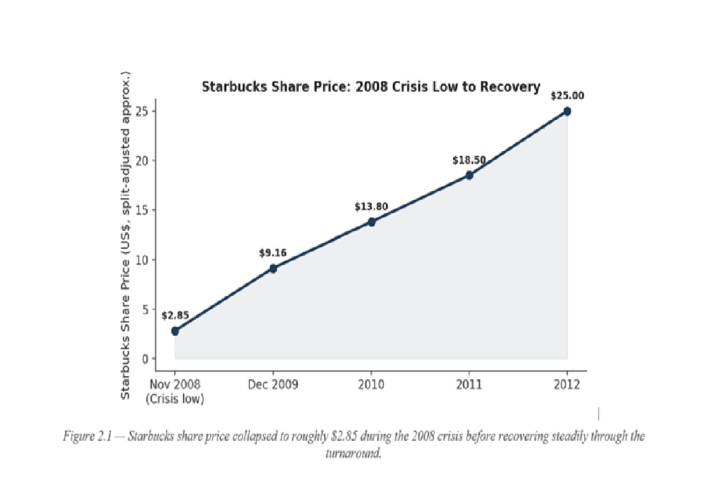
Figure 2.1 — Starbucks share price collapsed to roughly $2.85 during the 2008 crisis before recovering steadily through the turnaround.
5. Change / Measured Impact
The store closures alone were estimated to reduce annual costs by roughly $850 million. Starbucks’ stock, which bottomed near $2.85 in November 2008, recovered to about $9.16 by the end of 2009 and continued climbing through the following years, reaching roughly $25 by 2012 as comparable-store sales growth returned on a more sustainable base. Beyond the financial recovery, the episode reset Starbucks’ internal culture around customer experience as the primary success metric, a principle the company has referenced in subsequent strategic communications for over a decade.
Discussion Questions
- What early signals might have alerted Starbucks’ leadership to the erosion of in-store experience before the crisis became acute?
- Was closing every store for retraining — at a direct, quantifiable revenue cost — a justifiable decision? How would you measure its return on investment?
- How should a services business balance rapid geographic growth against maintaining a consistent, differentiated customer experience?